
Made in the UK from 100% recycled polypropylene
Application guidance
Protect buggy routes, maintenance access and overflow areas while respecting the surrounding landscape.
Why it matters
Golf courses concentrate wear into narrow corridors: buggy routes, mowers on the same lines every cut, trolleys at the same pinch points. The turf browns, then rutting starts, then the route that protects the course becomes the scar across it.
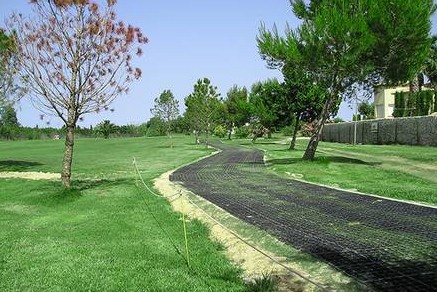
X-Grid lets a course build routes that disappear into the turf. Green X-Grid filled with root-zone soil and seed carries buggy and mower wheels on a reinforced surface while reading — and mowing — as grass. The 93% open structure drains as it falls, so the route does not channel water across playing surfaces.
panels per square metre of route
open structure — no surface water
Who this guidance is for
Route choice does most of the work: grid the lines wheels already take, and the surface stops fighting the course.
Approved build-up guidance
Cut the route line to a level, free-draining formation on the course’s own soils.
A compacted free-draining aggregate layer sized for buggy and compact mower loads.
A membrane where the formation is soft, keeping the aggregate layer intact.
Green X-Grid interlocked full width along the route; the cells take the wheels, the panels take the load.
Free-draining root-zone soil and the course seed mix, seeded or turfed, established under managed traffic.
The finished route mows over with the surrounding turf — no kerbs, no scar.
Key facts
panels per square metre of route
open structure — no surface water
disappears under established turf
frost-proof, mower-safe
Specifying discipline
Straight answers
Grass-filled X-Grid: the reinforced surface carries buggy and mower wheels while reading as turf. Park Avenue’s grassed routes — rebuilt on the same principle — no longer rut and can be mown over.
No — green panels filled with the course’s own root-zone mix and seed blend in; from the tee you see turf, not plastic.
Other applications
Create a stable, permeable gravel driveway with an installation build-up matched to ground and traffic conditions.
Reinforce gravel or grass parking bays, overflow parking and circulation areas with a durable cellular system.
Build permeable access routes for service, maintenance and managed vehicle traffic, with ground and drainage design matched to the project.
Stabilise gateways, yards, tracks and high-wear equestrian areas with appropriate drainage and build-up.
Reinforce farm access, yards and routes where ground conditions and vehicle loading demand a robust design.
Support campsite pitches, access and parking with permeable grass or gravel surfaces designed for seasonal traffic and site drainage.
Create practical paths, garden surfaces and suitable bases for lightweight garden structures.
Prepare a stable, level and free-draining grid base where the complete installation is designed for the filled load.
An indicative panel count, build-up and material schedule for any application on this site, reviewed by the technical team.
Every build-up above assumes the same published panel data: 330 × 330 mm cells, 40 mm deep, nine panels per square metre, a slot-and-peg interlock and a working range of −50 °C to +90 °C.